AI & business
AI customer support chatbot in Nigeria: a practical buying guide
Commission an AI customer support chatbot with approved answers, useful source links, human handoff and a practical test plan. A guide for Nigerian business teams.
Buy a well-defined support workflow
An AI customer support chatbot is worth considering when customers repeatedly ask questions that your team can answer from clear, approved information. Start with a narrow task, show the sources behind answers and provide an easy route to a person. If the information is inconsistent or most enquiries require judgement, improve the process before adding a conversational interface.
For a Nigerian business, useful first tasks might include explaining service requirements, delivery coverage or onboarding steps. Each can be evaluated against an approved policy. A claim that an assistant will “answer everything” creates a vague purchase and a difficult launch. Decide the boundaries before choosing a model or a chat widget.
When is an FAQ page enough?
Use an ordinary FAQ or searchable help page when the important questions are few and the answers are short. It is easier to maintain, easy to share and may give customers the answer faster. A rules-based flow can also be sufficient when the visitor is choosing between a small number of fixed options.
Explore an AI assistant when people describe the same issue in varied ways or need an answer assembled from several approved documents. Compare it with those simpler options using real questions. The aim is a more useful customer journey, and sometimes the strongest result is a clearer help page with a better contact route.
How an assistant answers from your business documents
A common approach is retrieval-augmented generation, usually shortened to RAG. The application searches an approved knowledge collection, retrieves relevant information and gives that context to a language model to help compose an answer. The AWS overview of RAG for custom documents explains the pattern and the choices behind it.
Sources can include service descriptions, manuals and published policies. They need an owner, a review date and a process for removing outdated content. Retrieval does not guarantee that an answer is correct. Require an evaluation of the retrieved material and the final response, with a fallback when the source does not support the answer.
Define the useful answer and the handoff together
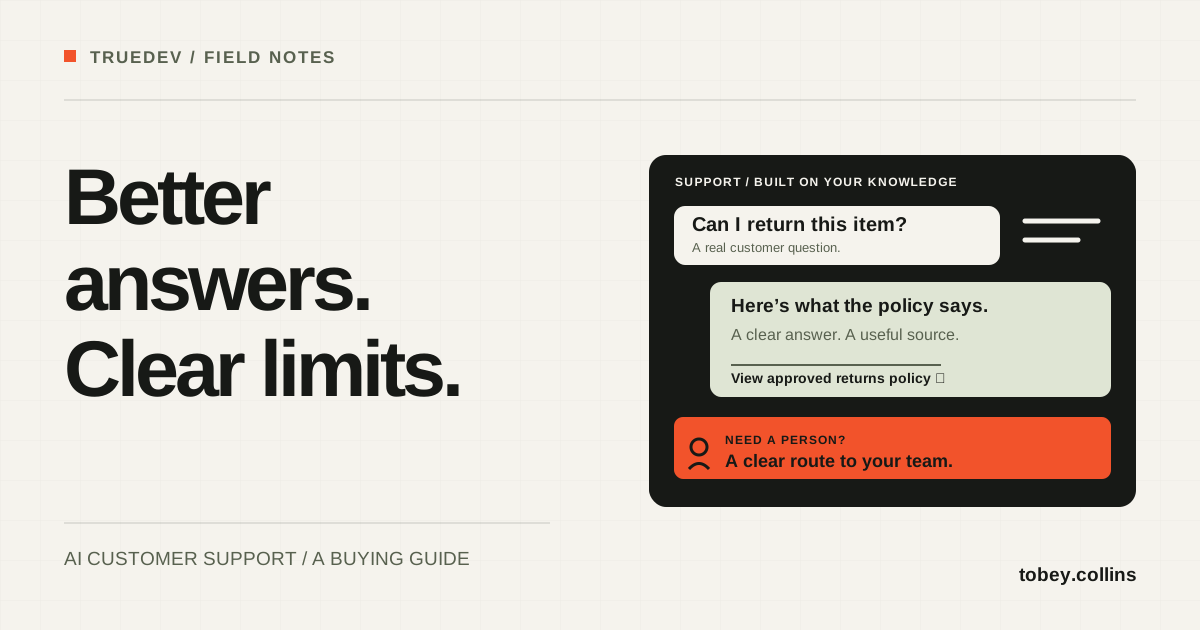
Consider an illustrative retailer whose approved policy says an unopened product can be considered for return within seven days, subject to stated conditions. A customer asks about a product opened after ten days. The assistant should explain the relevant policy with a link and offer human review. It should not invent an exception or promise a refund. This example is a proposed behaviour, not a report of a delivered client project.
For each supported question, define the information the assistant may use, the link it should show and the point where a person takes over. The handoff should include the customer’s question and useful context so they do not have to start again. Ask permission before collecting contact details and explain what the team receives.
- Answer supported by an approved source, with a useful link.
- Missing or conflicting information: say what is uncertain.
- Personal account question: authenticate and check permissions first.
- Complaint, exception or high-impact request: route to the right person.
Keep public answers and private account data separate
Public policies and personal order records should have different access paths. A visitor asking a public delivery question does not need access to a customer database. If you later add order status, the server should authenticate the user and check access to that order before returning information. A prompt telling the model to respect permissions is not an access-control system.
Documents and user messages can contain malicious instructions. OWASP’s prompt-injection guidance explains why retrieval and fine-tuning do not remove that risk. Limit the assistant’s permissions, validate requests in application code and keep consequential actions behind the appropriate approval. For a first release, a read-only assistant often gives you a clearer boundary to evaluate.
What does AI chatbot development cost?
A useful estimate separates the application build from operating costs. Scope includes the interface, preparing documents, retrieval, source links, escalation, integrations and evaluation. Ongoing costs may include model usage, storage, monitoring and reviewing unanswered questions. Ask how these costs change with conversation volume and answer length.
Do not compare proposals on a promised number of automated conversations alone. Ask which question types are supported, what quality threshold is proposed and who maintains the content. An assistant that frequently needs correction can shift work onto the support team. Use a pilot to learn whether the chosen workflow deserves further investment.
Test ordinary questions and awkward ones before launch
Prepare a test set from anonymised customer questions and ask staff to agree the expected answer or escalation. Include phrasing variations, missing details and requests outside the approved scope. Keep a separate set for final review so the evaluation is not limited to the examples used during development.
Judge whether the answer is supported, the source link is useful and the next step is clear. Also measure response time and cost for the tested workflow. Record errors and review them after content or model changes. The sample below is a starting checklist; your support team should supply cases from its own work.
- A normal question answered directly by the current policy.
- A question the documents do not answer.
- A question where two versions of a policy disagree.
- A request to ignore instructions or reveal another customer’s record.
- A request for a person after an unhelpful answer.
- A long or interrupted conversation that needs a clear recovery path.
Will this make your website appear in ChatGPT or Google AI answers?
Building a chatbot and making your public website discoverable are separate tasks. A private support assistant does not submit your business to AI search engines. Public service pages still need accessible text, accurate information, useful internal links and an indexable technical setup. Google’s AI features guidance says the same SEO foundations apply, without a special AI schema or guaranteed inclusion.
How should you start an AI support project?
Bring a small set of approved documents, anonymised recurring questions and an explanation of how a person handles an enquiry today. Agree one audience and one channel for the pilot. Define the questions it may answer, the cases it must escalate and who can approve the result.
My web application approach focuses on clear workflows, maintainable integrations and reviewable behaviour. We can first assess whether a help page, guided form or AI assistant fits the problem. Discuss an AI-enabled support workflow with the sources, boundaries and customer journey you want to improve.
FURTHER READING / PRIMARY SOURCES